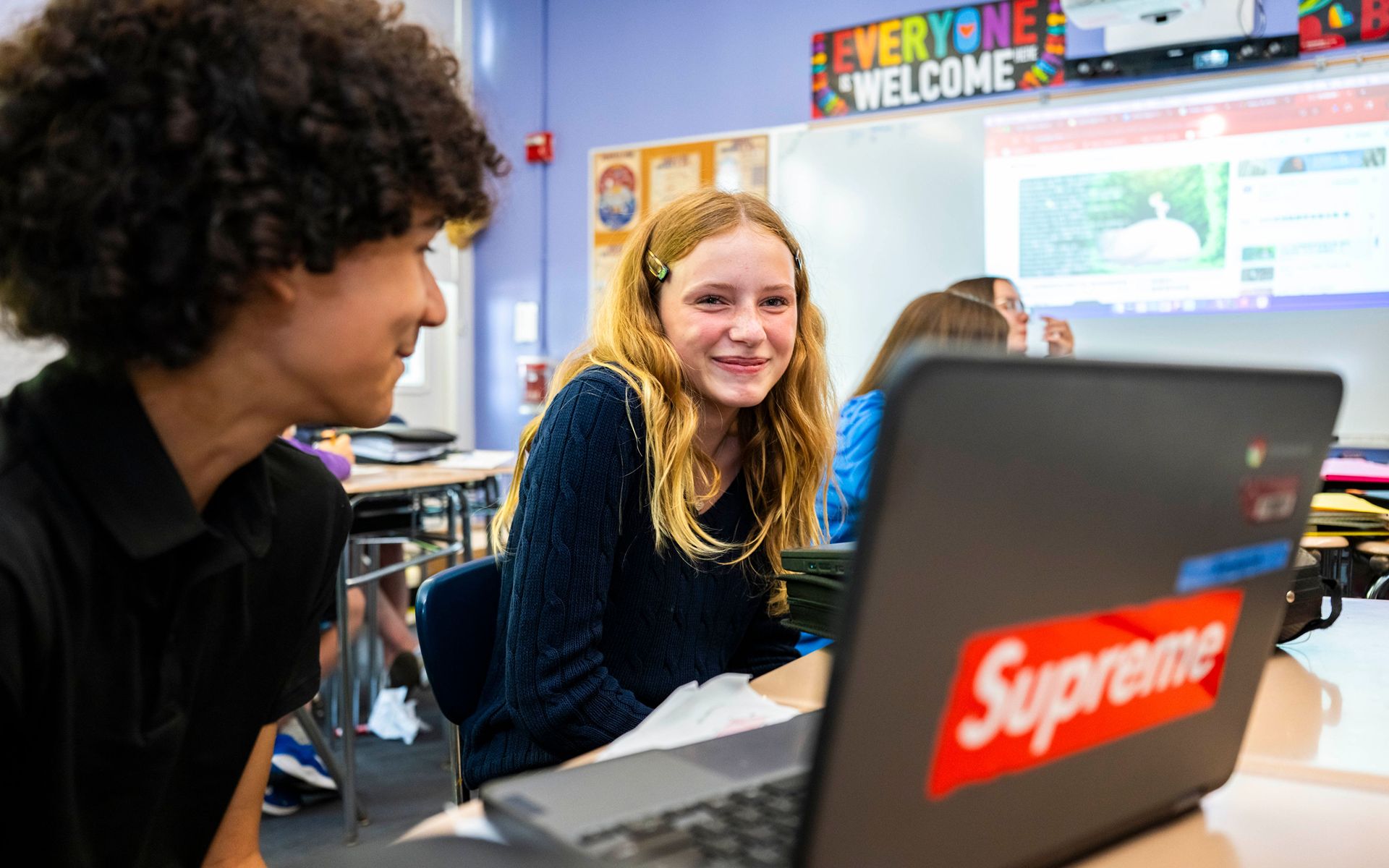
LREI Middle School is a place of bold questions and big ideas where students discover not only what they know, but who they are becoming. Learning here is active, collaborative, and purposeful. Students are encouraged to think critically, take intellectual risks, and engage deeply with the world around them.
This is school as it should be. Real learning happens when students are invited to wonder.
The curriculum is rooted in inquiry and designed to connect disciplines. It’s in the complexity of a text that sparks debate, the construction of a math model that mirrors real-world constraints, or the research that leads a student into the heart of a question they truly care about.
Fifth graders build the foundation for it all, exploring big questions, developing their voices, and learning to see the world with curiosity. Sixth graders reconstruct the growth of belief systems by studying geographical trade routes and religious tenets. Seventh graders investigate climate change and design scale models for a more resilient New York City. Eighth graders lead peer teach-ins and present original fieldwork on urgent political, social, and economic issues that they care about.
Young people are capable of extraordinary thinking when they are trusted with meaningful work.
Students are supported by educators who know them well and take them seriously. LREI teachers build learning experiences that help students wrestle with complexity and grow into their own voices. Trying something new is not always comfortable, and growth often comes with uncertainty. At LREI, students are encouraged to take risks in an environment grounded in respect, care, and belonging.
Teachers listen, guide, and model empathy and integrity, helping shape a community where no one is left in the shadows and each student is supported in becoming an engaged and thoughtful individual.
Life in the Middle School is built from more than academic classes. The structures below create rhythms, relationships, and opportunities to help students grow into themselves.
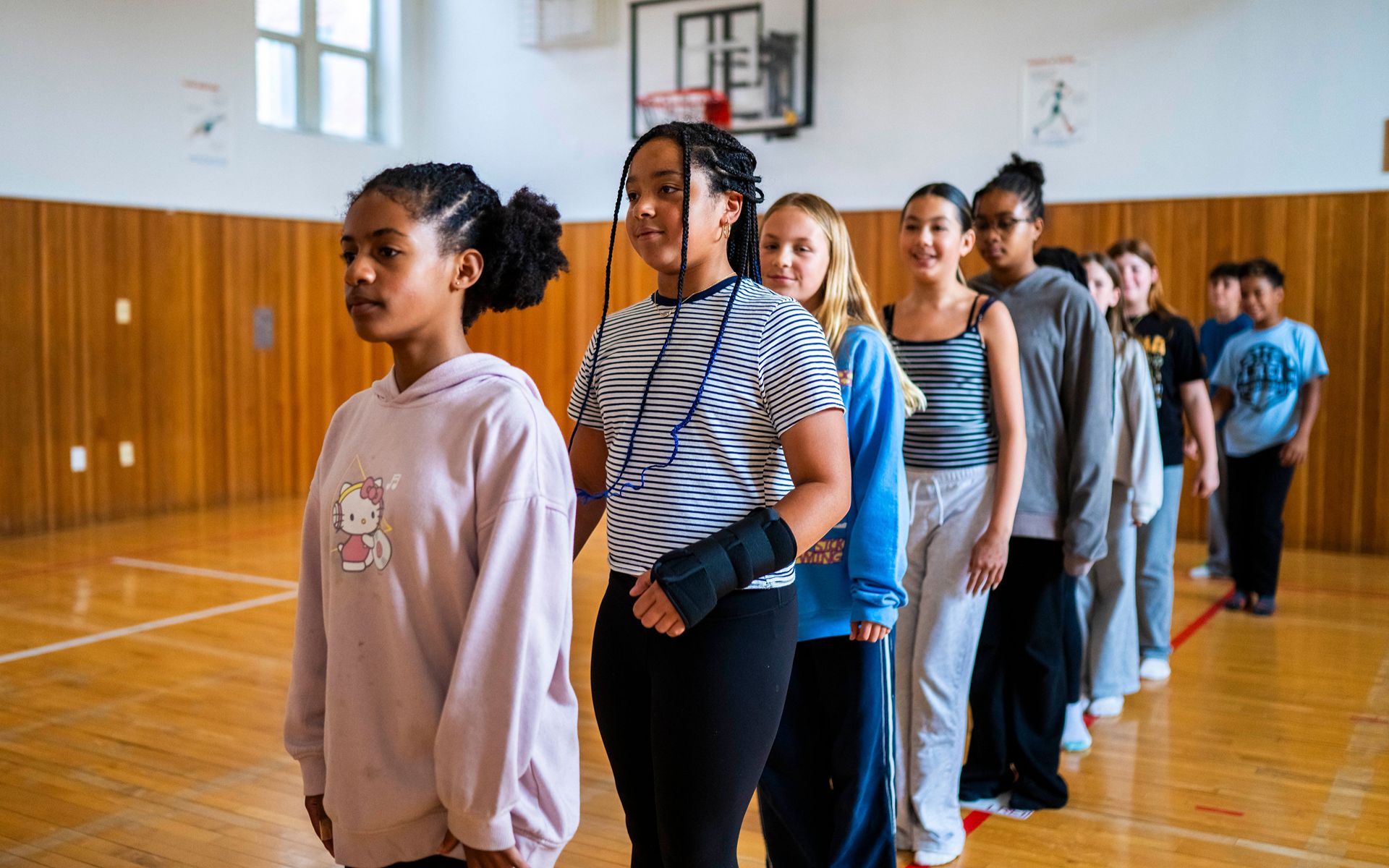
All middle schoolers have physical education three times a week. The goal is simple and powerful: to build skills and confidence. In a given unit, that might look like learning to serve in volleyball or to find space in a soccer game. It also looks like building trust with your classmates, taking risks, and improving over time.
That spirit shows up across the curriculum. One of the most beloved PE traditions is Dance of the Decades, a grade-level competition where student groups choreograph and perform original dances to music from a selected decade. Performances take place in front of faculty judges and a cheering audience of peers. The result is joyful, creative, and just the right amount of ridiculous. It’s also a perfect example of what makes PE meaningful here: students learn to move with purpose, express themselves physically, and build confidence through shared experience.
Athletics mirrors this same ethos. In fifth and sixth grade, students participate in seasonal intramurals for soccer, volleyball, and basketball. These teams are open to all and serve as a powerful introduction to what it means to be an athlete. Students learn the basics of teamwork, game strategy, and physical confidence, all while being coached by their own teachers and cheered on by classmates, faculty, and families.
In seventh and eighth grade, students can opt into travel teams, competing against other schools in soccer, volleyball, basketball, softball, and track. These teams practice after school and require a commitment. Tryouts don’t exist here. Everyone plays. Our belief is that participation leads to progress. Over time, the result is not just stronger athletes, but students who know how to support each other, take feedback, and show up with purpose.
And if you’re wondering, yes, we win championships.
Every middle schooler participates in a weekly seminar designed to match the questions and challenges that come with growing up. Formerly known as Adolescent Issues, the Choices program provides students with the tools and time to discuss the issues that may be weighing on their minds, including friendships, peer dynamics, relationships, technology use, safety, and more.
The program meets once a week by grade level, with a consistent faculty facilitator who works closely with students and their advisors. Our goal is not to hand students a script for how to live, but to create a structured, age-appropriate space where they can learn to articulate their values, explore big ideas, and reflect on their choices.
Content spirals over time, allowing students to revisit shared themes with growing nuance and complexity. The questions may evolve, but the core remains the same: How do we make thoughtful decisions for ourselves and others? For example, in fifth grade, when we talk about substances, we focus on everyday choices — sugar, caffeine, what we put on our lunch plates. That same conversation deepens each year. By eighth grade, students are exploring how to respond in real-world scenarios involving vaping, alcohol, and other moments when values and peer pressure might collide. Across all four years, students build the tools to reflect, speak honestly, and practice decision-making before they need to do it in the world.
Throughout, students are encouraged to speak openly, listen deeply, and support one another. We believe that adolescence is not a problem to be solved, but a powerful time of discovery. Choices is a place to practice navigating that journey with intention.
We want middle schoolers to try new things and to go deep in what they love. Our extracurricular program makes both possible.
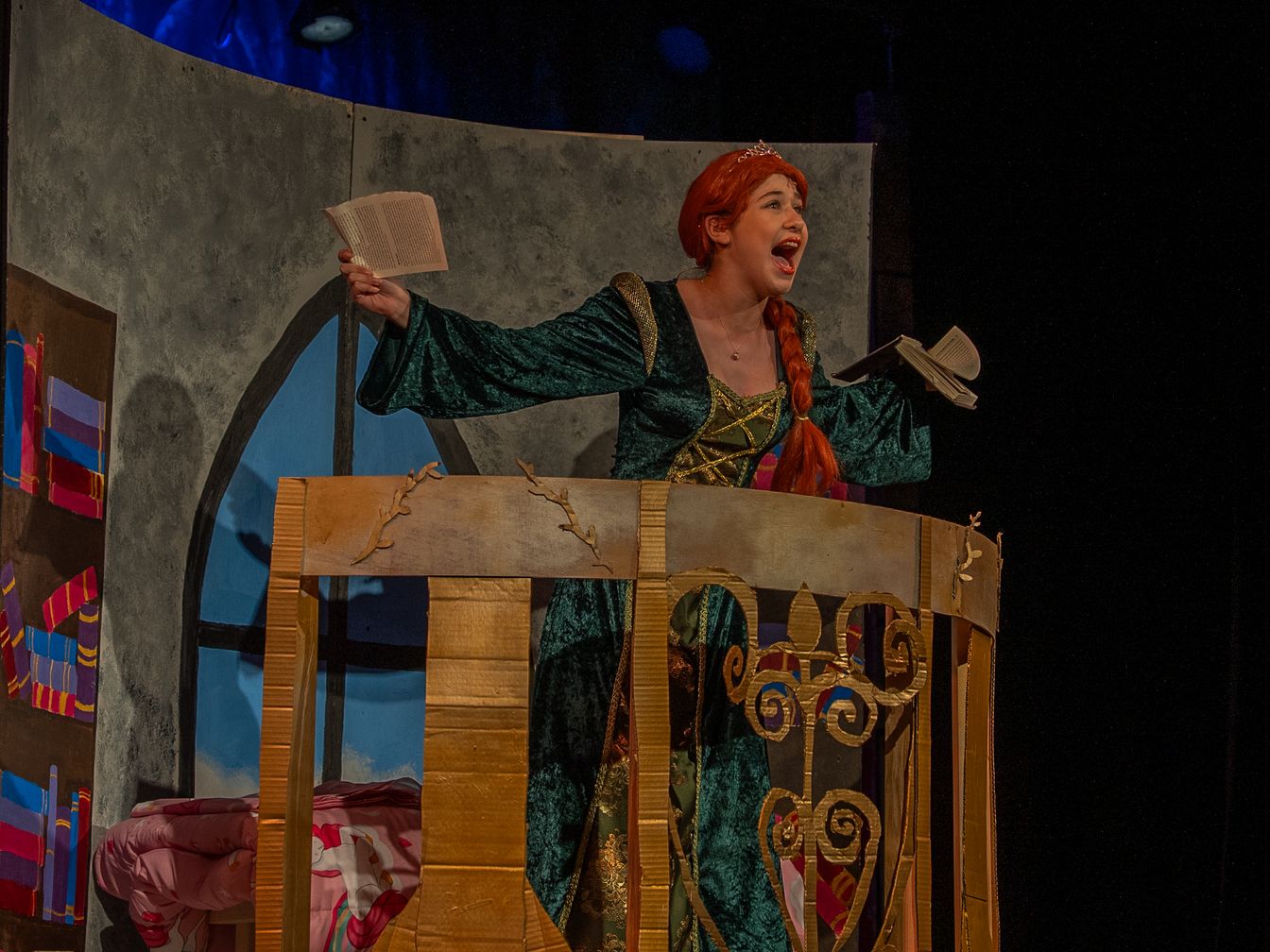
Some students spend their afternoons immersed in robotics, where they design, build, and code in preparation for local and national competitions. Others join our speech and debate team, growing their research skills and sparring with classmates on contemporary issues. Some contribute to our school-wide literary magazine, sharing original writing and editing peer submissions. Many spend the year in our theater program, which includes a Fall Play and a Spring Musical. True to our values, these productions are open to all: if you want to be in the show, you’re in the show. And acting isn’t the only option. Students take on costuming, lighting, set construction, and stage management, including calling the show from backstage.
Extracurriculars begin in sixth grade. We structure it this way intentionally. Fifth grade is a transitional year, when students learn how to navigate a new building, schedule, and set of expectations. Before layering in after-school commitments, we give them time to build independence, confidence, and community.
We know these experiences are more than hobbies. They are opportunities to practice collaboration, receive and offer feedback, take creative risks, and develop leadership skills. For some students, it’s also the moment when a passion takes root — an entry point into a lifelong interest or future pursuit.
Extracurriculars meet during and after the school day, with a mix of drop-in and ongoing commitments. We encourage students to try something new each season, but we also recognize that deepening a skill is equally important. Regardless of what they sign up for, students have the opportunity to explore and lead.
Core to our progressive practices is the belief that while we have a building where students learn, our classroom is the broader world. Field work is not an add-on or a special occasion. It’s part of how we teach. Students regularly step outside the building to investigate, observe, and engage. When they return, they bring with them not just content knowledge, but deeper curiosity and a broader sense of what learning can look like.
Each fall, middle schoolers embark on overnight trips that lay the groundwork for both academic and social foundations for the year ahead. Fifth and sixth graders travel together to an outdoor education center, where they hike, build shelters, and deepen the relationships that carry them through the year. Seventh graders head to New England, where they conduct primary source research and interviews to support their study of settler America. Eighth graders travel to Washington, D.C., where they study monuments and museums to support original memorial design work and in-depth knowledge of our government.
Field work doesn't stop with our overnights; it continues throughout the year. In science, seventh graders visit the Clearpool Model Forest to study New York City’s watershed system and examine the human impact on regional ecosystems. In Humanities, fifth graders travel to the Metropolitan Museum of Art to study artifacts from ancient civilizations. Mandarin students explore Chinatown to practice language skills and engage with cultural traditions. Across grades and disciplines, students take learning into the world and bring new insight back to the classroom.
We call it field work for a reason. It’s not just about going on a trip somewhere. It’s about doing something — collecting data, asking better questions, and learning to see the world as a place of insight and possibility.
Every year, each middle schooler is matched with an advisor, an adult in the building who knows them well, meets with them regularly, and partners with families across the year. Advisors serve as a steady presence, helping students navigate both academic and social life. Advisors are deeply embedded in the daily life of the school and regularly observe and interact with students across settings.
Advisory groups meet consistently throughout the year for structured conversations, activities, and check-ins. Students reflect on their habits, talk about their lives, explore current events, and plan for upcoming conferences. Advisors also help students problem-solve, build confidence, and develop self-advocacy skills. For families, the advisor is a central point of contact, someone who can speak to a student’s experience and help coordinate support when needed.
Homeroom is the daily structure that supports this work. Students begin and end each day in homeroom, where routines are established and relationships grow. Morning homeroom may include a schedule overview, a conversation circle, or time to organize backpacks and lockers. Afternoon homeroom helps students transition out of the school day, often featuring agenda checks, reminders, and opportunities to connect with teachers or visit the Learning Lab, which remains open until 4:30 p.m. for extra support.
Together, advisory and homeroom provide the consistency, connection, and care that students need to thrive in middle school.
Middle school is a time when students are figuring out how to belong. They are constantly asking, often without words: Where do I fit? Who am I becoming? How do I connect with others? We want students to explore those questions with curiosity and flexibility, knowing the answers may shift over time. That’s not just okay, it’s expected. Our job is to create a community where that kind of growth is possible.
Middle School Meeting, held weekly, brings the entire division together. Students lead the meeting, making announcements, celebrating athletic and extracurricular achievements, and often guiding the group in singing. It is a space where voices are elevated and contributions are seen, helping students feel connected to something larger than themselves.
One of the most beloved cross-grade traditions is the Middle School Olympics. Students are placed on a team when they enter the Middle School and remain on that team through eighth grade. These teams mix all grade levels and build relationships across the division. As students grow older, they take on leadership roles, helping younger teammates feel included and excited. The competitions are intentionally silly — relay races, oddball games, lip sync performances, and team flag-making — but the sense of pride and camaraderie is real.
Affinity Groups offer another layer of connection. Every student selects one each year based on a self-identified marker, such as race, gender, religion, or cultural identity. Some students even propose new ones. These groups meet regularly to talk about what’s happening in the world and celebrate who they are. They often lead Middle School Meeting, teaching their peers about their experiences and creating a more inclusive and informed community.
Each week ends with Activity Period, where students choose from a wide range of interest-based sessions. These offerings change each semester and might include food walking tours, board games, felting, improv, or a sunshine committee focused on spreading good energy. It’s a fun and low-stakes way to end the week, full of connection, creativity, and shared curiosity.
Even in the unstructured moments, such as lunch, recess, or passing time, students are practicing how to be in community. They learn to listen, include others, disagree respectfully, and speak up when something feels off. These aren’t just social skills. They’re essential parts of the lives we hope our students will go on to lead.